For my Humanities class, I had to pick a film and a scene within it that I thought best summed up the themes. Here’s SOME of my assignment! For no one’s interest, but mine!
Allow me to tell you how much I hate/love working full time, balancing movement/fitness classes, the stress of a Trump era (more hate), & a stacked semester all at once? It’s fantastic.
Thank god for films like Past Lives (2023, dir. and written by Celine Song) that fully transport you in their world. Thank god for women directors and writers. I feel like they see and pick up on nuances that are easily overlooked, and I look forward to Song’s next project.
Song was born on September 19, 1988, which (as a sorta late 80s baby) makes me notice things that she has Nora feel in this film more. The disbelief that Hae Sung hadn’t seen Eternal Sunshine of the Spotless Mind sticks out. I think that was in the trailer, or a longer clip I had seen of the film prior to deciding to watch it. Eternal Sunshine was my movie for a long, long time. I can’t tell you how many times I listened to Jon Brion’s music from it.
And I was right to assume I’d love it. Past Lives explores what-if’s and paths not taken, and Song’s decision to work with Christopher Bear and Daniel Rossen for the music was gut punchingly goddamn perfect.
Past Lives also explores the loss of cultural identity through Nora, who emigrates from South Korea to Canada with her family at the age of twelve. This shift at such a vulnerable age makes the film’s themes of nostalgia, distance, and the weight of life choices feel giant to me. I think this is often overlooked when I read other reviews, and maybe I make note of it more because I know only in the smallest way what it’s like to be uprooted from everything you know at age twelve. It creates a sense of longing for permanence and steadiness but it also forces you to adopt so many perspectives. I can’t begin to fathom the idea of shifting cultures.
We watch as Nora leaves behind her South Korean identity (Na Young 나영)and adopt an English name.
Nora reconnects with her childhood friend, Hae Sung, while they are both in college, over the internet. It’s interesting to notice her duality of self as she shares her life with him over Skype. She exists somewhere in between her past self (neither fully Western nor fully Korean) and her present self. Hae Sung represents the “what if?” I noted earlier. For her, he is perhaps a life she could’ve had if she never left.
Her excitement about their exchanges is evident, but her disappointment when they can’t connect wrecks her more, and she decides to end their interactions.
Past Lives theme that is felt throughout the whole film is the South Korean concept (which traces back to Buddhist and Confucian traditions) of In-Yun between Hae Sung and Nora, as well as In-Yun between Nora and the man she meets and eventually marries.
In-Yun (인연) translates roughly to “fateful connection” or “preordained relationship.”
It suggests that two people meeting is not random—it is the result of past-life connections or accumulated encounters across time.
The idea comes from Buddhist philosophy, where karma and past-life interactions shape present relationships.
By the time Nora meets up with Hae Sung again, she is an accomplished playwright and married living in New York City. And he is visiting for the week.
I chose the final scene to sum up the film. At first, I doubted my choice. Is this really it? But after rewatching it a hundred times for this analysis (and crying almost every single fucking time), I decided I’m not wrong.
At this stage, Hae Sung has spent a week visiting Nora after years of being in and out of her orbit.
This scene brings together everything: nostalgia, fate, identity, love, and loss. Hae Sung’s farewell is a callback to 인연 and his and Nora’s past.
Total Length: 6 minutes and 25 seconds
Begins: 1:32:09
Ends: 1:38:35
Total Number of Shots: 7
Analysis/Shot-by-Shot Description
Shot 1
Start/Stop Time – 1:32:09 to 1:35:07
Length – 2 minutes and 58 seconds
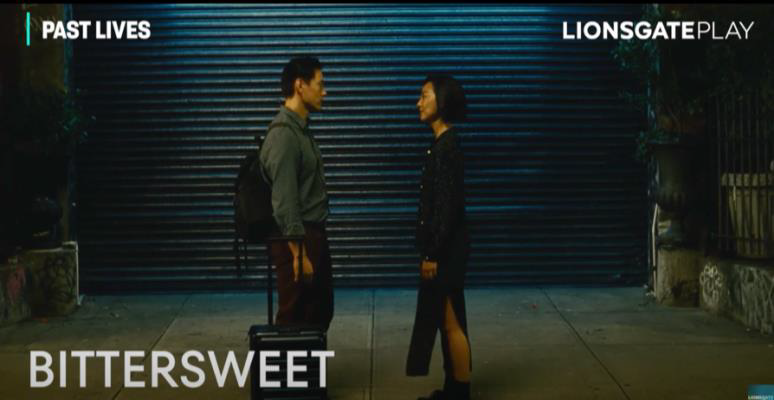
A long-wide tracking shot, straight-on angle. Hae Sung and Nora walk out of her front door to wait for his Uber and say goodbye. The camera follows them from a side profile angle as they walk along her street to the pick-up location.
There is no music, which makes the familiarity of the sadness in this type of goodbye feel even more unnerving. There’s the sound of the front door opening and closing, polite but strained smiles between them, the creak of the gate opening and latching behind them. The sound of sirens as Hae Sung looks at his phone, and they both look back together.
They stop in front of a closed storefront, and the camera is static with them. Graffiti covers the sidewalk and walls behind them. The scene softly lit by street lamps and a blue light. Nora’s skirt blows in the wind toward Hae Sung as they stare at one another deeply and thoughtfully.
The cool tones behind them contrast with the warm light on their faces. There is a physical distance between them, but a knowingness in how they stand, their feet directly pointed at each other.
The car pulls up suddenly, yanking us pretty unwillingly out of the moment. The car blocks the lower half of their bodies in the frame as they hug. Hae Sung looks sad, and Nora looks accepting. He walks to the car and is out of focus while Nora remains in focus as he puts his things in the backseat slowly, then turns to Nora and says, “Hey!” in Korean.
Annotation: The long tracking shot as it follows them from the long-wide straight-angle is perfect. The stillness, symmetry, and lighting choices amplify the feeling of intensity between them. There’s something evocative about this shot and the things unsaid that captured the pain and uncertainty before a goodbye.
Shot 2:
Start/Stop Time – 1:35:08 to 1:35:13
Length – 5 seconds
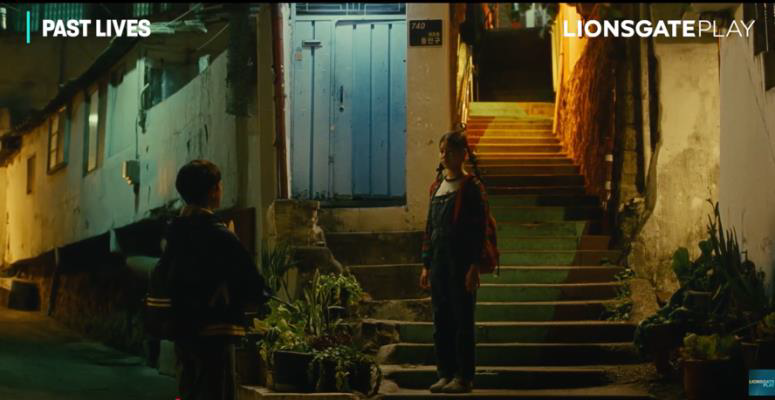
A sudden cut to a medium-wide shot, no camera movement, at a slightly lower angle. The shot shows Hae Sung and Nora as children, saying goodbye at night again in front of Nora’s home.
The perspective almost matches Hae Sung’s present-day view from the car as we look at the back of his head. They are also almost the same distance apart, looking at one another in silence. The only difference is their height—Nora is standing on a staircase while Hae Sung is below her on the street. The composition reinforces a sense of separation and imbalance from the past that is repeating in the present. The scene has similar colors, but is more warm, with nostalgic lighting: yellow-orange tones from the right side of the frame and once again we see a contrasting cool blue door behind Nora.
Annotation: The flash of this moment right after Hae Sung’s “Hey!” makes the viewer sit up. It’s also a visual parallel to their final goodbye scene as adults. The framing, lighting, and body language all reinforce the film’s theme of missed timing, longing, and the inevitability of moving forward and saying goodbye to a piece of yourself.
Shot 3:
Start/Stop Time – 1:35:14 to 1:35:19
Length – 5 seconds
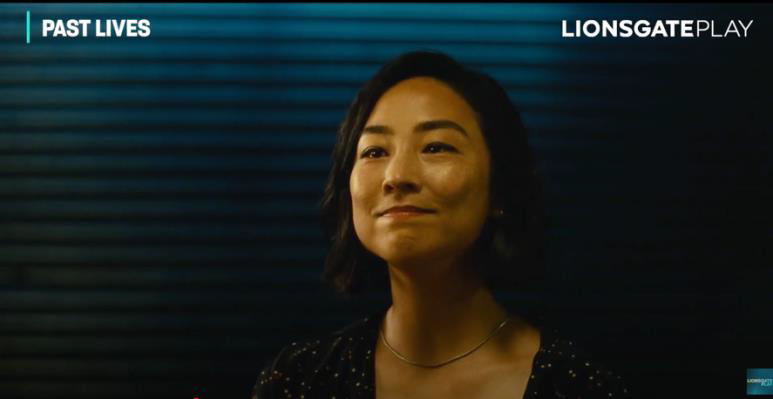
A cut to the present of a tight close-up, static, straight on shot of Nora. To me, Nora is beautiful and otherworldly in this shot. Something we are when we feel intense love.
We hear Hae Sung says her South Korean name “Na Young” with assertiveness off camera and she tilts her chin upward and smiles softly with pride. The lighting on her face from the street lamps is soft and low key and there’s a contrast between her face and the background. She says “Hm.” boldly back to him in response to her name.
Annotation: Nora’s expression of pride for her past self is beautiful after the glimpse of her childhood farewell. The way the shot lingers on her face as she is processing this moment is both powerful and heartbreaking.
Shot 4:
Start/Stop Time – 1:35:20 to 1:35:47
Length – 27 seconds
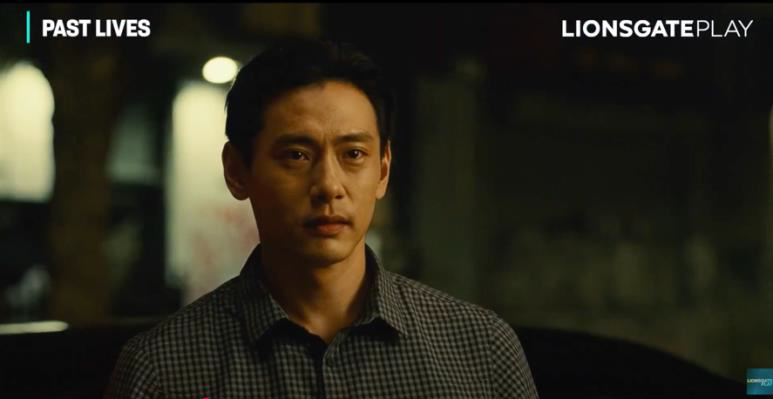
Cut to a tight close up, static, straight on angle shot of Hae Sung. He is visibly more sad than Nora. His brows slightly furrowed, his gaze a bit pained. The lighting is similar and low key, the background blurred with soft city lights behind him.
There is still no music lending itself to this moment between them, only the ambience of city noise, and Hae Sung’s steps as he walks even closer in frame to address Nora. He speaks again in Korean when he says, “What if this is a past life as well, and we are already something else to each other in our next life?” he pauses and reflects before adding, “Who do you think we are then?”
Annotation: The tight close-up on Hae Sung shows his deep longing and resignation. We wouldn’t be able to appreciate Teo Yoo’s (seemingly effortless) performance in this role as much if it were a medium wide shot.
Shot 5:
Start/Stop Time – 1:35:48-1:35:52
Length – 4 seconds
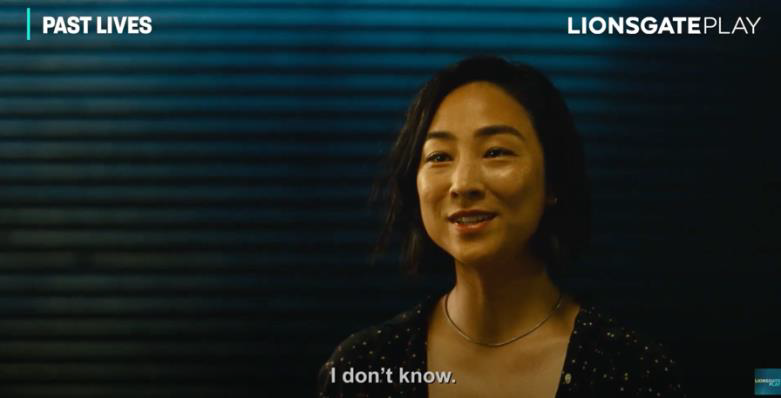
Cut back to a close up, static, slightly lower angle shot of Nora as she smiles and says back in Korean, “I don’t know.” The lighting is unchanged. The street lamps are making her face glow warmly against the same dark, cool blue tones behind her.
Annotation: the switch between the close-ups of the two of them, highlighting the contrast between Nora’s restrained sadness (with a smile) and Hae Sung’s sorrow accompanied by the city’s ambience, is too much.
Shot 6:
Start/Stop Time – 1:35:53 to 1:36:11
Length – 18 seconds
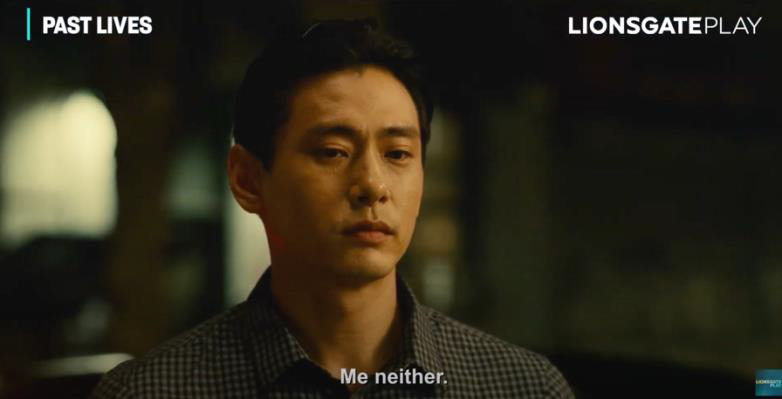
Cut to Hae Sung where we left him, close-up, static frame, at a straight on angle as he looks off to the side in pain and says, “Me neither.” Only to stare back directly at Nora, smile confidently, and say, “See you then.” His eyes stay on her as he turns away toward the car.
Annotation: The cut back to a close-up of Hae Sung as we absorb his quick acceptance is painful yet hopeful at once. As viewers we are conflicted over his processing.
Shot 7:
Start/Stop Time – 1:36:11-1:38:34
Length – 2 minutes and 23 seconds
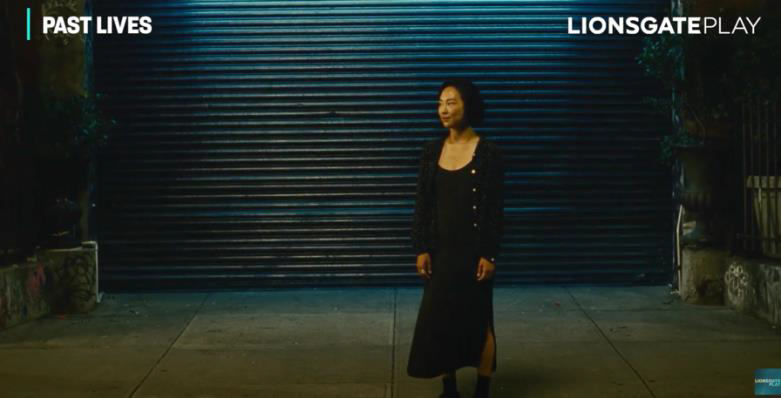
A cut back to the long wide shot where we left off in shot one. Nora is smiling tightly back at Hae Sung’s words, the blue feeling more stark behind her, the same soft glow of light on her face as Hae Sung is getting into the car. It drives off with nothing more between them.
Nora’s long skirt is blowing in the direction of the car, her hands by her sides in defeat feels which is a contrast to her smile. You can see her eyes glistening in this frame. She looks as if she’s not sure what to do with herself, her lips pursed together in resignation, maybe. She turns to walk back to her apartment, and piano notes begin as the camera follows at a side profile angle.
You can hear her steps as each haunting chord rings out, the music is emotional and weighty. The city sounds continue with it, keeping us rooted in the present but allowing us to float into the past. The frames take her by apartment buildings: one with a bright red door, then a much darker lit building with intricate mirrored windows, back into bright light again with a closed storefront behind her, as we follow her emotional walk away from Hae Sung and her past self.
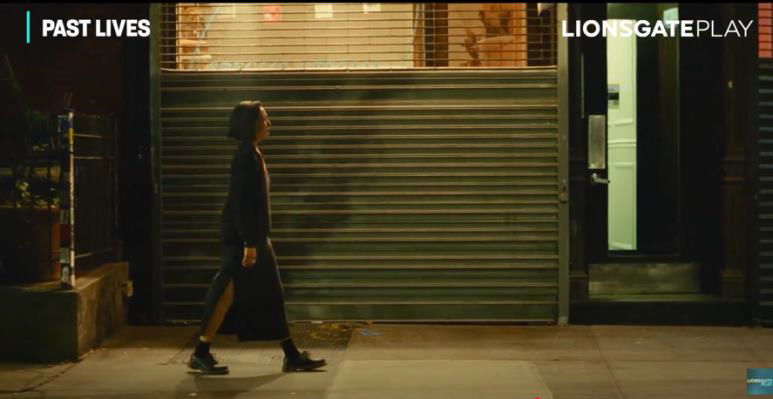
As she walks, we notice her face and body language move through moments of listlessness to acceptance: she tugs at her sweater, blinking up and away. The piano progression picks up in intensity, following our own heartbeat alongside hers.
We see her husband, Arthur, sitting on the steps of their apartment and feel her unexpected relief and need to be supported. He is to the far right of the frame, above her as she looks up and he puts out his cigarette. He looks down at her and we can see his concern. The lighting is soft from the street, and there’s a lit up red door behind them.
Arthur walks down the stairs and we hear the creak of the gate open. Nora is turned away from the camera but we know she is breaking down as Arthur pulls her in and we hear her finally release her anguished sobs.
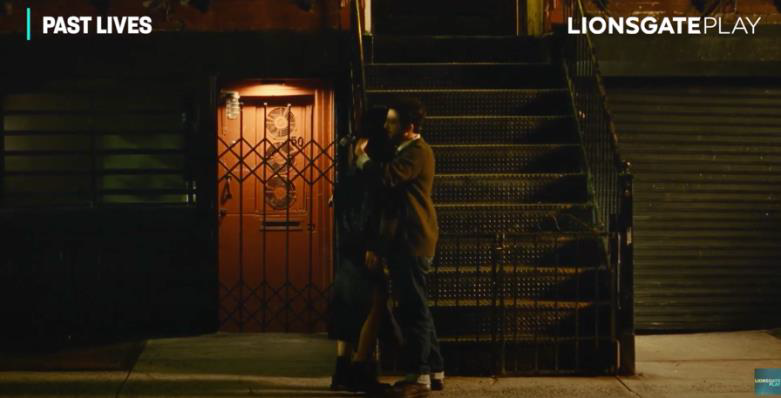
He lets her cry and then they look at one another before she continues to openly weep, he opens the gate and they walk slowly up the stairs together, his hand on her back.
Annotation: This scene was perfection as the camera followed Nora from Hae Sung’s departure (away from her past) back to her home (into the present). Movement as a metaphor is one theme that comes to mind with this shot. Even as she keeps walking, the moment extends itself and we feel it deeply with her every step.
Arthur being there at the end and opening the gate for her when she had just closed it with Hae Sung only moments earlier felt poignant. We watch in a long wide shot with Nora turned away from us as she processes the life she never had (and her South Korean identity) and the life she has (her western life) with the most tender, yet loving, sadness.
If you made it this far and you want to watch a shorter version of this, please do so below:


Thoughts?